
OSHA Data Analysis
OSHA HazCom Violations: What the Data Reveals and How to Be Prepared
In the past three years, there were more than 10,000 OSHA inspections with violations citing the HazCom [29 CFR 1910.1200 (opens in a new window)] standard. Let’s dive deep into the insights uncovered by industry and how to be protected.

Published · 7 min read
Key takeaways
- 10,878 OSHA inspections cited the Hazard Communication standard (29 CFR 1910.1200) between October 2023 and August 2026.
- The written HazCom program, 1910.1200(e)(1) (opens in a new window), is the most-cited paragraph: it appears on 7,016 inspections, 64% of the total.
- Construction is most often cited for missing safety data sheets; manufacturing for unlabeled workplace containers.
- Inspections citing only HazCom averaged $1,724 in fines. The 86% that also cited other standards averaged $10,038.
- The costliest combination is manufacturing with 1910.1200(h)(3) (opens in a new window), required training content, at $26.5k per inspection on average.
HazCom is a paperwork citation with a price tag that depends on what else the inspector finds
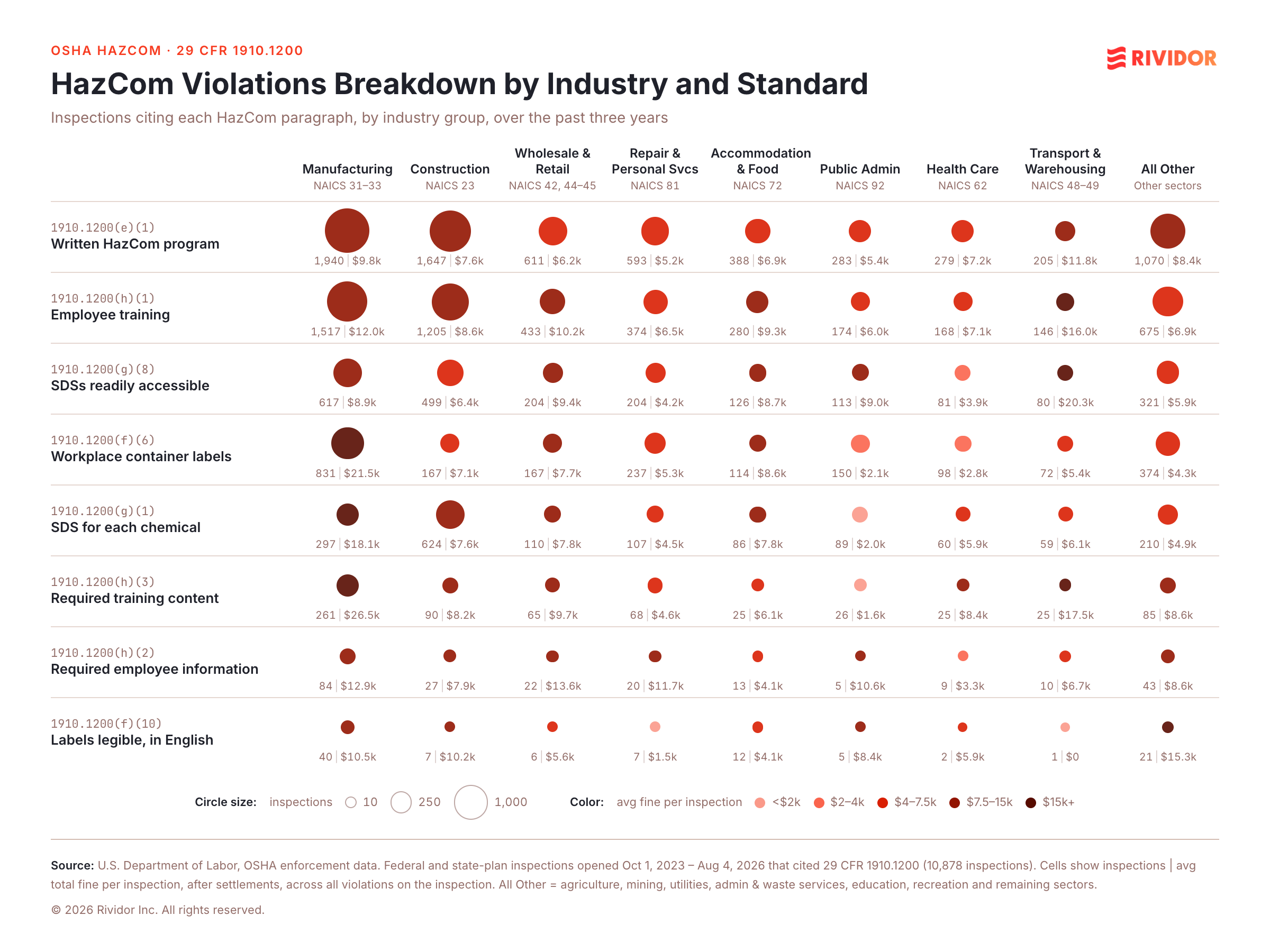
Over the past three years, 10,878 OSHA inspections cited the Hazard Communication standard. In every industry, the written program and employee training are the two most-cited paragraphs. The third is either safety data sheets or labels, depending on the industry, and the cost of an inspection varies even more.
- inspections cited HazCom in three years
- 10,878
- of them cited the written program, (e)(1) (opens in a new window)
- 64%
- also cited something other than HazCom
- 86%
- in HazCom penalties, 20% of the total
- $19.7M
Which HazCom paragraphs does OSHA cite most?
These eight paragraphs of 29 CFR 1910.1200 cover every HazCom requirement cited on 100 or more inspections. One inspection can cite several paragraphs, so the shares add up to more than 100%.
| Paragraph | Requirement | Inspections | Share |
|---|---|---|---|
| 1910.1200(e)(1) (opens in a new window) | Written HazCom program | 7,016 | 64% |
| 1910.1200(h)(1) (opens in a new window) | Employee training | 4,972 | 46% |
| 1910.1200(g)(8) (opens in a new window) | SDSs readily accessible | 2,245 | 21% |
| 1910.1200(f)(6) (opens in a new window) | Workplace container labels | 2,210 | 20% |
| 1910.1200(g)(1) (opens in a new window) | SDS for each chemical | 1,642 | 15% |
| 1910.1200(h)(3) (opens in a new window) | Required training content | 670 | 6% |
| 1910.1200(h)(2) (opens in a new window) | Required employee information | 233 | 2% |
| 1910.1200(f)(10) (opens in a new window) | Labels legible, in English | 101 | 1% |
Five things that stand out
- The written program comes first. (e)(1) (opens in a new window) appears on 7,016 inspections, nearly two in three. In construction it is on 77% of HazCom inspections, and in repair shops and restaurants/hotels on 71%. If an employer has one HazCom citation, it is usually this one.
- Construction is missing SDSs; manufacturing is missing labels. Construction accounts for 38% of inspections citing (g)(1) (opens in a new window) (no SDS on file) but only 8% of those citing (f)(6) (opens in a new window) (container labels). Manufacturing is the reverse: (f)(6) (opens in a new window) shows up on 25% of its HazCom inspections, against 9% for (g)(1) (opens in a new window). Chemicals arriving at a jobsite lose their paperwork, and chemicals decanted on a plant floor lose their labels.
- The smallest column carries the biggest fines. Transport & Warehousing has the fewest HazCom inspections (362), yet it has the highest average fine in each of the three most-cited rows: $11.8k for the written program, $16.0k for training and $20.3k for SDS access.
- Detailed citations mean bigger cases. In manufacturing, inspections citing the broad training requirement (h)(1) (opens in a new window) average $12.0k. Those citing the specific training content, (h)(3) (opens in a new window), average $26.5k, the highest cell on the chart. An inspector who checks what the training covered is usually running a longer, wider inspection.
- Public employers pay the least. Public Administration has the lowest average fine in three rows: labels ($2.1k), SDS on file ($2.0k) and training content ($1.6k). This is consistent with state plans, which cover most public employers and often reduce or waive their penalties.
Which HazCom citations cost the most?
Average total fine per inspection, after settlements, for industry and paragraph combinations with at least 25 inspections.
| Industry | Paragraph | Inspections | Avg fine |
|---|---|---|---|
| Manufacturing | (h)(3) (opens in a new window) Required training content | 261 | $26.5k |
| Manufacturing | (f)(6) (opens in a new window) Workplace container labels | 831 | $21.5k |
| Transport & Warehousing | (g)(8) (opens in a new window) SDSs readily accessible | 80 | $20.3k |
| Manufacturing | (g)(1) (opens in a new window) SDS for each chemical | 297 | $18.1k |
| Transport & Warehousing | (h)(3) (opens in a new window) Required training content | 25 | $17.5k |
More from the data
- Gaps come in clusters. Almost half of these inspections (49%) cited two or more HazCom paragraphs, and a quarter cited three or more. A missing program usually means missing training and missing SDSs as well.
- Most HazCom citations are rated serious. Of 20,611 HazCom line items, 58% were serious and 39% other-than-serious. Only 495 were repeats and 28 were willful.
- Manufacturing is the largest share. Factories account for 31% of HazCom inspections and have a large bubble in every row. Construction is next at 20%.
- Auto shops are a hotspot. Repair & Personal Services has 835 HazCom inspections, 82% of them in repair and maintenance (NAICS 811). Fines there are mostly modest ($4–7k), but the citations keep coming.
- About one in five cost nothing. 2,360 inspections (22%) closed with no fine at all after settlements.
How to avoid the most common HazCom citations
- Write the program down, and keep it specific to the site. It is the citation most likely to be issued. You don’t have to start from a blank page: OSHA’s Small Entity Compliance Guide (opens in a new tab) includes a sample written program in Appendix A, and some state-plan OSHA programs publish their own templates.
- In construction, make the SDS travel with the product: no chemical arrives on site without its SDS.
- In manufacturing, label every secondary container. Decanted chemicals are where (f)(6) (opens in a new window) citations come from.
- Keep training records that show what was covered, not just who attended. That is the gap behind (h)(3) (opens in a new window), the most expensive cell on the chart.
Full data: HazCom citations by paragraph and industry
Each cell shows the number of inspections citing that paragraph, then the average total fine per inspection.
| Paragraph | Manufacturing | Construction | Wholesale & Retail | Repair & Personal Svcs | Accommodation & Food | Public Admin | Health Care | Transport & Warehousing | All Other |
|---|---|---|---|---|---|---|---|---|---|
| (e)(1) (opens in a new window) Written HazCom program | 1,940 · $9.8k | 1,647 · $7.6k | 611 · $6.2k | 593 · $5.2k | 388 · $6.9k | 283 · $5.4k | 279 · $7.2k | 205 · $11.8k | 1,070 · $8.4k |
| (h)(1) (opens in a new window) Employee training | 1,517 · $12.0k | 1,205 · $8.6k | 433 · $10.2k | 374 · $6.5k | 280 · $9.3k | 174 · $6.0k | 168 · $7.1k | 146 · $16.0k | 675 · $6.9k |
| (g)(8) (opens in a new window) SDSs readily accessible | 617 · $8.9k | 499 · $6.4k | 204 · $9.4k | 204 · $4.2k | 126 · $8.7k | 113 · $9.0k | 81 · $3.9k | 80 · $20.3k | 321 · $5.9k |
| (f)(6) (opens in a new window) Workplace container labels | 831 · $21.5k | 167 · $7.1k | 167 · $7.7k | 237 · $5.3k | 114 · $8.6k | 150 · $2.1k | 98 · $2.8k | 72 · $5.4k | 374 · $4.3k |
| (g)(1) (opens in a new window) SDS for each chemical | 297 · $18.1k | 624 · $7.6k | 110 · $7.8k | 107 · $4.5k | 86 · $7.8k | 89 · $2.0k | 60 · $5.9k | 59 · $6.1k | 210 · $4.9k |
| (h)(3) (opens in a new window) Required training content | 261 · $26.5k | 90 · $8.2k | 65 · $9.7k | 68 · $4.6k | 25 · $6.1k | 26 · $1.6k | 25 · $8.4k | 25 · $17.5k | 85 · $8.6k |
| (h)(2) (opens in a new window) Required employee information | 84 · $12.9k | 27 · $7.9k | 22 · $13.6k | 20 · $11.7k | 13 · $4.1k | 5 · $10.6k | 9 · $3.3k | 10 · $6.7k | 43 · $8.6k |
| (f)(10) (opens in a new window) Labels legible, in English | 40 · $10.5k | 7 · $10.2k | 6 · $5.6k | 7 · $1.5k | 12 · $4.1k | 5 · $8.4k | 2 · $5.9k | 1 · $0 | 21 · $15.3k |
Methodology
- Source: U.S. Department of Labor OSHA enforcement data, federal and state-plan inspections.
- Scope: inspections opened October 1, 2023 through August 4, 2026 (the latest HazCom inspection in the data) that cited 29 CFR 1910.1200, in every industry including construction: 10,878 inspections.
- Paragraphs are rolled up to the second level, so a citation of 1910.1200(f)(6)(ii) (opens in a new window) counts as (f)(6) (opens in a new window). An inspection is counted once per paragraph, however many line items cite it.
- Average fine is the mean of each inspection’s total current penalty, after settlements, across all of its violations, not just HazCom. Paragraph-level penalties are unreliable because grouped items carry the whole penalty on one line and $0 on the rest.
- Industry groups follow NAICS sectors. “All Other” covers agriculture, mining, utilities, administrative and waste services, education, recreation and the remaining sectors.
Frequently asked questions
What is the most common OSHA HazCom violation?
The written hazard communication program, 29 CFR 1910.1200(e)(1) (opens in a new window). It was cited on 7,016 of the 10,878 OSHA inspections that cited HazCom between October 2023 and August 2026, or 64%. Employee training, 1910.1200(h)(1) (opens in a new window), is second at 4,972 inspections.
How much does an OSHA HazCom violation cost?
It depends on what else is cited. Inspections that cited HazCom and nothing else averaged $1,724 in total fines after settlements. Inspections that cited HazCom alongside other standards averaged $10,038. About two-thirds of individual HazCom line items carry a $0 penalty, often because they are grouped with another violation.
Which industry gets the most OSHA HazCom citations?
Manufacturing, with 3,377 inspections, or 31% of all HazCom inspections from October 2023 to August 2026. Construction is second with 2,149 (20%), followed by wholesale and retail trade with 938.
What SDS violations does OSHA cite most often?
Two paragraphs cover safety data sheets. 1910.1200(g)(8) (opens in a new window), which requires SDSs to be readily accessible to employees during each work shift, was cited on 2,245 inspections. 1910.1200(g)(1) (opens in a new window), which requires an SDS for each hazardous chemical, was cited on 1,642. Construction accounts for 38% of the (g)(1) (opens in a new window) citations.
Which HazCom citations carry the highest fines?
Manufacturing inspections citing 1910.1200(h)(3) (opens in a new window), required training content, averaged $26.5k in total fines, the highest of any industry and paragraph combination with at least 25 inspections. Manufacturing inspections citing (f)(6) (opens in a new window), workplace container labels, were next at $21.5k.
Where does this data come from?
U.S. Department of Labor OSHA enforcement data, covering federal and state-plan inspections opened October 1, 2023 through August 4, 2026 that cited 29 CFR 1910.1200. Fines are each inspection's total current penalty after settlements, across all violations on the inspection.